
wendy lyn
Introduction
Measuring materials correctly is one of the most important parts of any construction, remodeling, flooring, fencing, woodworking, and home-improvement project. A small mistake in measurement can result in buying too much material, running short during installation, or creating unnecessary waste. One of the most common measurement questions is how to convert linear feet to square feet.
The conversion is useful when a material is sold by linear feet but the project area is measured in square feet. Examples include carpet, flooring, fabric, countertops, lumber, siding, trim, wallpaper, and other materials that have a known width.
The important thing to understand is that linear feet and square feet measure different things. Linear feet measure length, while square feet measure area. Therefore, you cannot convert linear feet to square feet without knowing the material’s width.
A Linear Feet to Square Feet Calculator makes this process much easier. By entering the number of linear feet and the width of the material, you can quickly determine the equivalent square footage.
For example, if you have 20 linear feet of material that is 3 feet wide:
Square Feet = Linear Feet × Width
Square Feet = 20 × 3 = 60 square feet
This article explains how the conversion works, how to use a free Linear Feet to Square Feet Calculator, common applications, examples, mistakes to avoid, and practical tips for estimating materials.
What Are Linear Feet?
A linear foot is a measurement of length.
Unlike square feet, linear feet do not describe an area. They simply describe how long something is.
For example:
- 1 linear foot = 1 foot of length
- 10 linear feet = 10 feet of length
- 25 linear feet = 25 feet of length
- 100 linear feet = 100 feet of length
The width of the material is not included in a linear-foot measurement.
Imagine a roll of carpet that is 12 feet wide. If you purchase 10 linear feet of that carpet, you have:
- Length: 10 feet
- Width: 12 feet
The total area is therefore:
10 × 12 = 120 square feet
The same 10 linear feet can represent very different amounts of square footage depending on width.
What Are Square Feet?
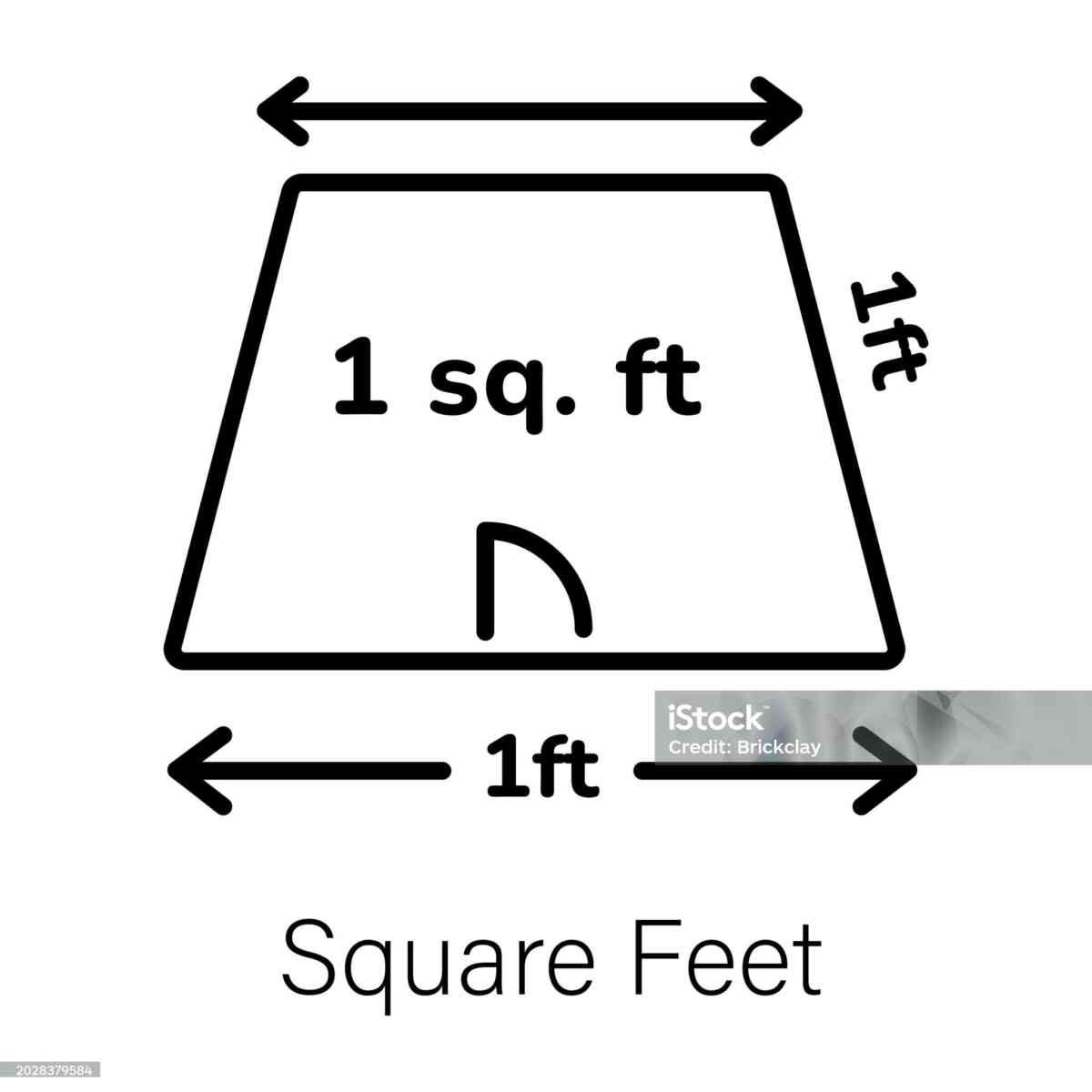
A square foot is a measurement of area.
One square foot is the area of a square measuring:
1 foot × 1 foot
If a rectangular room is 12 feet long and 10 feet wide, its area is:
12 × 10 = 120 square feet
Square footage is commonly used to measure:
- Floors
- Walls
- Ceilings
- Roof surfaces
- Carpet areas
- Tile areas
- Countertops
- Land
- Paintable surfaces
Because square feet represent area, both length and width are required.
The Difference Between Linear Feet and Square Feet
The easiest way to remember the difference is:
Linear feet = length
Square feet = area
Consider a board that is 8 feet long and 1 foot wide.
It contains:
8 linear feet
and:
8 square feet
But if the same 8-foot-long material is 2 feet wide, it contains:
8 × 2 = 16 square feet
So the number of linear feet remains the same, but the square footage doubles.
Linear Feet to Square Feet Formula
The standard formula is:
Square Feet = Linear Feet × Width in Feet
This formula works when the width is expressed in feet.
Example
Suppose you have 30 linear feet of material that is 4 feet wide.
30 × 4 = 120 square feet
Therefore:
30 linear feet of 4-foot-wide material = 120 square feet
What If the Width Is in Inches?
Many materials have widths measured in inches rather than feet.
For example, flooring, carpet, fabric, boards, trim, and other materials may have widths such as:
- 6 inches
- 12 inches
- 18 inches
- 24 inches
- 36 inches
- 48 inches
- 60 inches
- 72 inches
Before calculating square footage, convert the width from inches to feet.
The formula is:
Width in Feet = Width in Inches ÷ 12
Then:
Square Feet = Linear Feet × Width in Feet
Combining the formulas gives:
Square Feet = Linear Feet × Width in Inches ÷ 12
Example
You have 40 linear feet of material that is 36 inches wide.
First convert 36 inches to feet:
36 ÷ 12 = 3 feet
Then:
40 × 3 = 120 square feet
Therefore, 40 linear feet of 36-inch-wide material covers 120 square feet.
How to Use a Free Linear Feet to Square Feet Calculator
A calculator simplifies the process.
Typically, you enter:
- Number of linear feet
- Material width
- Width unit, if supported
The calculator then determines the square footage.
For example:
Linear Feet: 50
Width: 2 feet
Result: 100 square feet
If the width is entered as 24 inches:
50 × 24 ÷ 12 = 100 square feet
The calculator eliminates repetitive manual calculations and reduces the risk of arithmetic errors.
Linear Feet to Square Feet Conversion Table
The following examples assume the material width is measured in feet.
| Linear Feet | 1-Foot Width | 2-Foot Width | 3-Foot Width | 4-Foot Width | 5-Foot Width |
|---|---|---|---|---|---|
| 5 | 5 sq ft | 10 sq ft | 15 sq ft | 20 sq ft | 25 sq ft |
| 10 | 10 sq ft | 20 sq ft | 30 sq ft | 40 sq ft | 50 sq ft |
| 20 | 20 sq ft | 40 sq ft | 60 sq ft | 80 sq ft | 100 sq ft |
| 30 | 30 sq ft | 60 sq ft | 90 sq ft | 120 sq ft | 150 sq ft |
| 40 | 40 sq ft | 80 sq ft | 120 sq ft | 160 sq ft | 200 sq ft |
| 50 | 50 sq ft | 100 sq ft | 150 sq ft | 200 sq ft | 250 sq ft |
| 100 | 100 sq ft | 200 sq ft | 300 sq ft | 400 sq ft | 500 sq ft |
This table demonstrates why width is essential.
There is no single conversion factor from linear feet to square feet.
Why There Is No Universal Linear Feet-to-Square-Feet Conversion
A common mistake is assuming that one linear foot always equals a particular number of square feet.
That is not correct.
One linear foot of:
- 1-foot-wide material = 1 square foot
- 2-foot-wide material = 2 square feet
- 3-foot-wide material = 3 square feet
- 4-foot-wide material = 4 square feet
- 5-foot-wide material = 5 square feet
- 10-foot-wide material = 10 square feet
The width determines the conversion.
This is why a Linear Feet to Square Feet Calculator requires both measurements.
Converting Flooring From Linear Feet to Square Feet
Flooring is one of the most practical applications.
Suppose a flooring product is sold by linear feet and comes in a fixed width of 12 inches.
You purchase 100 linear feet.
Because 12 inches equals 1 foot:
100 × 1 = 100 square feet
Now consider flooring that is 6 feet wide.
If you purchase 100 linear feet:
100 × 6 = 600 square feet
The same number of linear feet represents six times as much area because the material is six times wider.
Carpet and Linear Feet
Carpet is often sold in rolls with standard widths, although the exact width varies by product.
Suppose carpet is 12 feet wide and you need 25 linear feet.
The theoretical area is:
25 × 12 = 300 square feet
However, actual carpet purchasing can be more complicated because seams, room dimensions, pattern matching, installation direction, and waste can affect the amount required.
A basic linear-feet-to-square-feet calculation provides an area estimate, but it should not automatically be treated as the final installation quantity.
Fabric Applications
Fabric is frequently sold by linear yards or linear feet.
If fabric is 4 feet wide and you purchase 15 linear feet:
15 × 4 = 60 square feet
If the fabric is 54 inches wide, first convert:
54 ÷ 12 = 4.5 feet
Then:
15 × 4.5 = 67.5 square feet
This can be useful for estimating fabric quantities for upholstery, curtains, cushions, covers, and other projects.
Countertop Applications
Countertops can also be measured using linear feet.
A countertop may have a standard depth, such as 25.5 inches or another manufacturer-specified dimension.
Suppose you have 12 linear feet of countertop with a depth of 25.5 inches.
Convert the depth:
25.5 ÷ 12 = 2.125 feet
Then:
12 × 2.125 = 25.5 square feet
The calculation gives the approximate surface area.
For purchasing and fabrication, however, sink cutouts, backsplashes, seams, overhangs, and other design factors must also be considered.
Siding and Exterior Materials
Some siding products are sold using linear measurements while wall surfaces are measured in square feet.
If siding is 1 foot wide and you purchase 200 linear feet:
200 × 1 = 200 square feet
If the actual coverage width is 8 inches:
8 ÷ 12 = 0.6667 feet
Then:
200 × 0.6667 ≈ 133.34 square feet
For siding, always use the manufacturer’s stated effective coverage width rather than assuming the nominal width.
Lumber and Boards
Linear feet are especially common in lumber purchasing.
A board may be described as:
- 8 linear feet
- 10 linear feet
- 12 linear feet
- 16 linear feet
But lumber area calculations require width.
For example, a board 12 feet long and 1 foot wide contains:
12 square feet
A board 12 feet long and 2 feet wide contains:
24 square feet
For traditional dimensional lumber, other measurements such as board feet may be more appropriate than square feet, depending on the purpose of the calculation.
Linear Feet to Square Feet for Walls
Suppose you need to cover a wall with a material that is 2 feet wide.
The wall requires 40 linear feet of material.
The coverage is:
40 × 2 = 80 square feet
If the material is 18 inches wide:
18 ÷ 12 = 1.5 feet
40 × 1.5 = 60 square feet
Again, width is the key variable.
Calculating Square Footage From Multiple Linear Sections
Some projects have several sections with different lengths.
For example:
- Section A: 10 linear feet
- Section B: 15 linear feet
- Section C: 20 linear feet
If all material is 3 feet wide:
Total linear feet:
10 + 15 + 20 = 45 linear feet
Then:
45 × 3 = 135 square feet
Alternatively, calculate each section separately:
10 × 3 = 30
15 × 3 = 45
20 × 3 = 60
Total:
30 + 45 + 60 = 135 square feet
Both methods produce the same result when the width is identical.
What Happens When Widths Differ?
If sections have different widths, calculate each section separately.
For example:
Section A:
10 linear feet × 2 feet = 20 square feet
Section B:
15 linear feet × 3 feet = 45 square feet
Section C:
20 linear feet × 4 feet = 80 square feet
Total:
20 + 45 + 80 = 145 square feet
Using the total linear feet multiplied by one width would be incorrect because the widths are different.
Adding a Waste Allowance
A basic area calculation does not automatically account for waste.
Construction materials may require additional material because of:
- Cutting
- Trimming
- Defective pieces
- Pattern matching
- Seams
- Installation errors
- Irregular room shapes
- Obstacles
- Directional patterns
If the calculated area is 500 square feet and you decide to add 10%:
500 × 1.10 = 550 square feet
The appropriate waste allowance depends heavily on the material and installation method.
For a simple rectangular project, waste may be relatively low. A complex layout can require substantially more.
Linear Feet to Square Feet for a Rectangular Area
The conversion can also be understood using the standard rectangle formula:
Area = Length × Width
When linear feet represent the length, the calculation becomes:
Area = Linear Feet × Width
Since area is measured in square feet:
Square Feet = Linear Feet × Width in Feet
This is simply the standard rectangle area formula applied to a material sold by length.
Common Mistakes
Mistake 1: Ignoring Width
The most serious mistake is attempting to convert linear feet without knowing the width.
There is no valid square-foot result without a width.
Mistake 2: Forgetting to Convert Inches
If width is 24 inches, do not multiply directly by 24.
Convert first:
24 ÷ 12 = 2 feet
Mistake 3: Confusing Linear Feet With Square Feet
A 20-foot-long material is not automatically 20 square feet.
Its square footage depends on width.
Mistake 4: Ignoring Actual Coverage Width
Some products have nominal dimensions that differ from their actual coverage.
Mistake 5: Forgetting Waste
The mathematical area may be lower than the quantity required for installation.
Mistake 6: Mixing Units
Avoid combining feet and inches without conversion.
When Should You Use a Linear Feet to Square Feet Calculator?
A calculator is especially useful when:
- Material is sold by linear feet
- The project is measured in square feet
- Width is known
- You need repeated calculations
- You are comparing material quantities
- You are estimating project costs
- You want to reduce manual calculation errors
It can be particularly valuable for contractors, installers, homeowners, designers, estimators, and DIY users.
Estimating Project Cost
Once square footage is known, you can estimate material costs.
Suppose your project requires 400 square feet and the material costs $4.50 per square foot.
Estimated material cost:
400 × $4.50 = $1,800
If you add 10% extra material:
400 × 1.10 = 440 square feet
Then:
440 × $4.50 = $1,980
The additional material increases the estimated cost but can reduce the risk of running short.
Final Thoughts
Converting linear feet to square feet is straightforward when the material width is known.
The core formula is:
Square Feet = Linear Feet × Width in Feet
If width is measured in inches:
Square Feet = Linear Feet × Width in Inches ÷ 12
The calculation is useful for flooring, carpet, fabric, countertops, siding, wall coverings, and many other materials.
A free Linear Feet to Square Feet Calculator can make these calculations faster and easier, especially when comparing several material options or estimating large projects.
Always remember that the basic calculation provides mathematical area. Real-world purchasing may require additional consideration for waste, seams, cutting, patterns, installation direction, and manufacturer specifications.
For accurate estimating, measure carefully, use the actual material coverage width, maintain consistent units, and add an appropriate allowance for installation waste.


