tina hils
Introduction
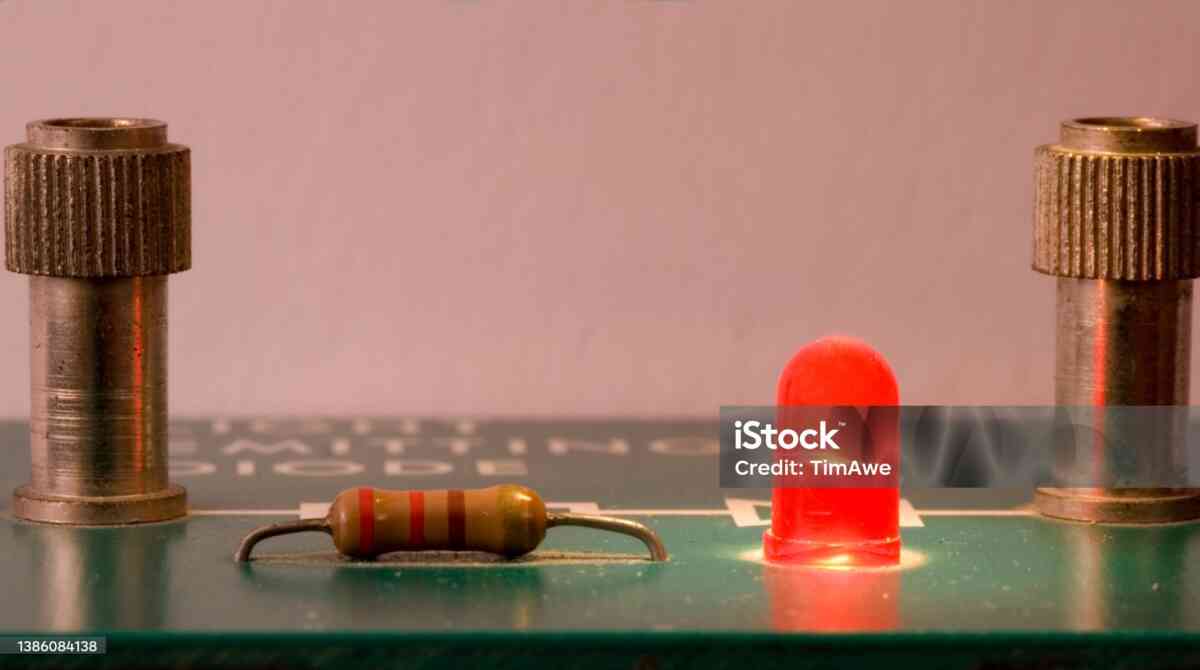
LEDs are among the most useful electronic components ever developed. They are inexpensive, efficient, compact, reliable, and available in countless colors, sizes, brightness levels, and electrical specifications. From simple indicator lights to automotive lighting, consumer electronics, industrial control panels, microcontroller projects, and sophisticated lighting systems, LEDs are everywhere.
However, connecting an LED directly to a voltage source can be a serious mistake.
Unlike many ordinary loads, an LED does not naturally regulate the amount of current flowing through itself. Once the voltage across the LED reaches its forward-voltage region, a relatively small increase in voltage can produce a large increase in current. Excessive current can cause an LED to become extremely hot, lose brightness, suffer permanent damage, or fail completely.
This is why a current-limiting resistor is commonly placed in series with an LED.
An LED Resistor Calculator is a free online tool designed to make this calculation quick and convenient. Instead of manually rearranging equations and converting units, users can enter their supply voltage, LED forward voltage, and desired LED current and obtain an appropriate resistor value.
The basic calculation is:
R=VS−VFIR=frac{V_S-V_F}{I}
where:
- RR = required resistor resistance in ohms
- VSV_S = supply voltage
- VFV_F = LED forward voltage
- II = desired LED current in amperes
The calculator can also help estimate resistor power dissipation, which is important when selecting a safe physical resistor.
This guide explains how an LED resistor calculator works, how to choose the correct inputs, how to calculate resistor values manually, how resistor power affects component selection, and how to avoid common LED circuit mistakes.
What Is an LED Resistor Calculator?
An LED Resistor Calculator is a digital calculation tool that determines the resistance required to limit current through an LED.
A typical calculator asks for three primary values:
- Supply voltage
- LED forward voltage
- Desired LED current
For example, suppose you have:
- 9 V supply
- 2.0 V red LED
- 20 mA desired current
The resistor calculation is:
R=9−20.020R=frac{9-2}{0.020} R=350 ΩR=350 Omega
The theoretical value is therefore 350 Ω.
Because standard resistor values are used in practical circuits, you might select a nearby standard value such as 360 Ω. Choosing a slightly higher resistance reduces current and generally provides additional safety for the LED.
A good calculator may also calculate the resistor’s power requirement.
For the 360 Ω example:
I=9−2360I=frac{9-2}{360} I≈19.4 mAIapprox19.4text{ mA}
The resistor power is approximately:
P=I2RP=I^2R P≈(0.0194)2(360)Papprox(0.0194)^2(360) P≈0.135 WPapprox0.135text{ W}
A 1/4 W resistor would therefore provide a reasonable margin for this example.
Why Does an LED Need a Resistor?
An LED is a semiconductor diode. Its current-voltage relationship is nonlinear.
This means that an LED should not normally be connected directly to a fixed-voltage power supply unless the circuit has another mechanism for controlling current.
Imagine connecting a typical red LED directly to a 5 V source.
The LED might have a forward voltage of approximately 2 V under a particular operating condition. That does not mean the LED will simply consume the remaining 3 V safely.
Instead, the LED attempts to conduct current according to its electrical characteristics. Without current limiting, the current may become excessive.
The result can be:
- overheating
- reduced LED lifespan
- permanent damage
- sudden failure
- unstable operation
- excessive current consumption
- possible damage to the power source or driver
A series resistor solves this problem by absorbing the voltage difference and restricting current.
The resistor does not make the LED’s forward voltage constant in every situation. Instead, it helps establish a predictable operating current under normal conditions.
The Basic LED Resistor Formula
The most commonly used formula is:
R=VS−VFIR=frac{V_S-V_F}{I}
This formula comes directly from Ohm’s law.
The resistor receives the difference between the supply voltage and the LED’s forward voltage.
Supply Voltage
The supply voltage is the voltage provided by the circuit.
Examples include:
- 3 V battery
- 3.3 V microcontroller supply
- 5 V USB supply
- 9 V battery
- 12 V automotive system
- 24 V industrial supply
LED Forward Voltage
LED forward voltage varies according to LED technology, color, current, temperature, and manufacturer.
Typical approximate values include:
| LED type | Approximate forward voltage |
|---|---|
| Red | 1.8–2.2 V |
| Orange | 2.0–2.2 V |
| Yellow | 2.0–2.4 V |
| Green | 2.0–3.2 V |
| Blue | 2.8–3.5 V |
| White | 2.8–3.6 V |
These are general ranges rather than guaranteed values.
For precise designs, use the forward-voltage specification in the LED manufacturer’s datasheet.
LED Current
The desired LED current determines brightness and electrical load.
A common assumption for older indicator LEDs is 20 mA, but modern LEDs frequently provide adequate brightness at much lower currents.
Possible design currents include:
- 2 mA
- 5 mA
- 10 mA
- 15 mA
- 20 mA
Always check the LED datasheet rather than assuming that 20 mA is required.
Example: 5 V Supply and Red LED
Suppose you want to operate a red LED from a 5 V supply.
Assume:
- VS=5VV_S=5V
- VF=2VV_F=2V
- I=20mAI=20mA
Convert milliamps to amps:
20mA=0.020A20mA=0.020A
Now calculate:
R=5−20.020R=frac{5-2}{0.020} R=150ΩR=150Omega
A 150 Ω resistor is the theoretical value.
The resistor power is:
P=I2RP=I^2R P=(0.020)2(150)P=(0.020)^2(150) P=0.06WP=0.06W
A resistor rated at 1/4 W would therefore have substantial power margin.
Example: 12 V Supply and Red LED
Now consider a 12 V supply and the same red LED.
Assume:
- Supply = 12 V
- Forward voltage = 2 V
- Current = 20 mA
R=12−20.020R=frac{12-2}{0.020} R=500ΩR=500Omega
A practical standard value might be 510 Ω.
Current using 510 Ω:
I=12−2510I=frac{12-2}{510} I≈19.6mAIapprox19.6mA
The resistor power is:
P≈0.196WPapprox0.196W
A 1/4 W resistor would be a reasonable minimum choice under these assumptions, although additional margin can be desirable, particularly where ambient temperatures are high.
Example: 3.3 V Supply and White LED
Consider a white LED with:
- Supply voltage = 3.3 V
- LED forward voltage = 3.0 V
- Desired current = 10 mA
R=3.3−3.00.010R=frac{3.3-3.0}{0.010} R=30ΩR=30Omega
A standard value such as 33 Ω could be selected.
But this example illustrates an important design issue: the voltage difference between the supply and LED forward voltage is small.
A small change in LED forward voltage or supply voltage can significantly affect current.
For this reason, circuits with very little voltage headroom require more careful design.
How to Use a Free LED Resistor Calculator
A typical free LED resistor calculator can be used in a few simple steps.
Step 1: Determine the Supply Voltage
Identify the voltage available to the LED circuit.
Examples:
- 3.3 V
- 5 V
- 9 V
- 12 V
- 24 V
Do not confuse nominal battery voltage with actual voltage under all operating conditions.
For example, a nominal 12 V automotive electrical system can experience voltage levels substantially different from 12 V while charging or under varying electrical loads.
Step 2: Find the LED Forward Voltage
Look at the LED datasheet.
If the datasheet provides a typical forward voltage and a maximum value, understand which value is appropriate for your design.
For a simple estimate, a typical forward voltage may be sufficient.
For precision designs, use the manufacturer’s electrical characteristics and account for tolerances.
Step 3: Select the Desired Current
Determine how much current the LED should receive.
Do not automatically select the maximum current.
If an LED provides adequate brightness at 5 mA, there is often little reason to operate it at 20 mA.
Lower current can reduce:
- power consumption
- heat
- stress
- battery drain
Step 4: Enter the Values
Enter the supply voltage, forward voltage, and current into the calculator.
The calculator determines the resistance required.
Step 5: Check Resistor Power
The resistor must be able to dissipate the heat generated by the circuit.
A useful equation is:
PR=I2RP_R=I^2R
Another equivalent calculation is:
PR=(VS−VF)IP_R=(V_S-V_F)I
Both produce the same theoretical result.
Step 6: Select a Standard Resistor
The exact calculated value may not correspond to a commercially available resistor.
Choose an appropriate standard value.
When protecting an LED, selecting the next higher resistance is often preferable because it reduces current.
Choosing the Correct Resistor Value
Suppose your calculation produces 347 Ω.
Possible commercially available values could include:
- 330 Ω
- 360 Ω
- 390 Ω
Using 330 Ω results in more current than the calculated value.
Using 360 Ω results in slightly less current.
For LED protection, 360 Ω may be the more conservative choice if brightness remains satisfactory.
This is one reason calculators should be treated as design aids rather than automatic guarantees.
LED Resistor Power Rating
Resistance alone is not enough.
A resistor also has a power rating.
Common ratings include:
- 1/8 W
- 1/4 W
- 1/2 W
- 1 W
- 2 W
- higher-power ratings
If your calculation says the resistor dissipates 0.2 W, a 1/4 W resistor might work under appropriate conditions.
However, designing exactly at the resistor’s maximum rating leaves little thermal margin.
A better approach is to select a resistor with a comfortable power rating above the calculated dissipation.
Why Resistor Power Matters
Electrical energy converted into heat must go somewhere.
A resistor dissipating power becomes warm.
If the resistor is operated beyond its rated power, it can:
- become excessively hot
- change resistance
- suffer long-term degradation
- fail
- create a thermal hazard in unsuitable installations
Therefore, a good LED resistor calculator should ideally display both resistance and resistor power.
LED Current and Brightness
More current does not necessarily mean proportionally more useful brightness.
LED brightness depends on:
- LED design
- wavelength
- current
- optical efficiency
- viewing angle
- temperature
- lens design
- application
Modern high-efficiency LEDs can produce significant light at relatively low current.
This makes low-current operation attractive for indicator applications.
For example, an LED that appears sufficiently bright at 5 mA may not need to operate at 20 mA.
Reducing current can extend battery life and reduce heat.
Series LED Circuits
Multiple LEDs can sometimes be connected in series.
In a series string, the LED forward voltages are added.
For example:
- LED 1 = 2.0 V
- LED 2 = 2.0 V
- LED 3 = 2.0 V
Total forward voltage:
VF,total=6VV_{F,total}=6V
With a 12 V supply and 20 mA desired current:
R=12−60.020R=frac{12-6}{0.020} R=300ΩR=300Omega
A standard value such as 330 Ω may be appropriate depending on the design objective.
The same current flows through each LED because they are in series.
Why Parallel LEDs Need Care
Putting LEDs directly in parallel is often discouraged when each LED is expected to share current equally.
LEDs can have different forward voltages.
The LED with the lower forward voltage can conduct more current. That increased current can further alter its operating condition, potentially causing uneven current distribution.
For multiple LEDs, common approaches include:
- one resistor per LED
- separate constant-current drivers
- properly designed series strings
An LED resistor calculator can be used for each independently limited branch.
LED Resistor Calculator for Microcontroller Projects
Microcontrollers frequently provide 3.3 V or 5 V logic outputs.
Suppose a microcontroller output drives a red LED.
Assume:
- Output voltage = 3.3 V
- LED forward voltage = 2.0 V
- desired current = 5 mA
Then:
R=3.3−2.00.005R=frac{3.3-2.0}{0.005} R=260ΩR=260Omega
A standard 270 Ω resistor could be used.
However, the microcontroller’s output current specifications must also be respected.
The fact that an LED resistor calculation produces a valid current does not automatically mean the microcontroller pin can safely source or sink that current.
Always check the microcontroller datasheet.
LED Resistor Calculator for Arduino-Style Projects
Many development boards operate at 5 V or 3.3 V.
A resistor is commonly placed between a digital output and an LED.
For example:
5 V output → resistor → LED → ground
The resistor limits current.
If using a 2.0 V LED and targeting 10 mA:
R=5−20.010R=frac{5-2}{0.010} R=300ΩR=300Omega
A 330 Ω resistor would provide slightly less than 10 mA.
This may still produce excellent brightness.
LED Resistor Calculator for 12 V Circuits
12 V LED projects are common in:
- automotive electronics
- control panels
- hobby electronics
- instrumentation
- signage
- DIY projects
Suppose you want a red LED at approximately 10 mA from a 12 V source.
Using a 2 V forward voltage:
R=12−20.010R=frac{12-2}{0.010} R=1000ΩR=1000Omega
A 1 kΩ resistor would therefore produce approximately:
I=101000I=frac{10}{1000} I=10mAI=10mA
Resistor power:
P=I2RP=I^2R P=(0.010)2(1000)P=(0.010)^2(1000) P=0.1WP=0.1W
A resistor with a power rating comfortably above 0.1 W would be appropriate.
Battery-Powered LED Applications
LEDs are frequently used in battery-powered devices because of their low power consumption.
The resistor calculation becomes particularly important because every milliwatt matters in low-power designs.
Suppose an LED is powered from a 3 V battery.
If the LED forward voltage is 2 V and current is 5 mA:
R=3−20.005R=frac{3-2}{0.005} R=200ΩR=200Omega
But as the battery voltage falls, LED current will also change.
This means a resistor-based LED circuit does not provide constant current across a wide battery voltage range.
For simple indicators, that may be perfectly acceptable.
For precision lighting applications, a constant-current driver may be more appropriate.
What Is Forward Voltage?
Forward voltage is the voltage associated with forward conduction of the LED.
It is not an absolute fixed voltage.
Forward voltage depends on:
- current
- temperature
- manufacturing variation
- LED chemistry
- wavelength
- semiconductor construction
For this reason, using a calculator with an approximate forward voltage gives an estimate rather than a laboratory-precise result.
The manufacturer’s datasheet is the best source for design values.
LED Forward Voltage Changes With Temperature
LED electrical characteristics change with temperature.
As junction temperature changes, forward voltage can change.
This is one reason high-power LED systems require more sophisticated thermal and current-control considerations than a simple indicator LED.
For basic hobby circuits, these changes may be relatively small compared with other design factors.
For high-power applications, they can become significant.
What Happens If the Resistor Is Too Small?
If the resistor value is too low, LED current increases.
Possible consequences include:
- excessive brightness initially
- excessive heating
- reduced lifetime
- LED failure
- resistor overheating
- power supply stress
For example, suppose a circuit theoretically requires 330 Ω but a 47 Ω resistor is installed.
The current could be dramatically higher.
This is why the resistor should be calculated rather than guessed.
What Happens If the Resistor Is Too Large?
A resistor that is too large reduces current.
The LED may:
- appear dim
- fail to produce the desired brightness
- still operate correctly at a lower current
Unlike using a resistor that is too small, using a somewhat larger resistor is generally a safer direction for LED current.
The trade-off is reduced brightness.
Common LED Resistor Calculation Mistakes
Mistake 1: Forgetting Unit Conversion
20 mA is:
0.020A0.020A
not 20 A.
A unit mistake can produce a dramatically incorrect resistor value.
Mistake 2: Ignoring LED Forward Voltage
Using:
R=VSIR=frac{V_S}{I}
instead of:
R=VS−VFIR=frac{V_S-V_F}{I}
can produce an unnecessarily high resistance.
The LED consumes part of the supply voltage.
Mistake 3: Assuming Every LED Is 2 V
Different LEDs have different forward voltages.
Red, green, blue, and white LEDs can have substantially different characteristics.
Use the datasheet whenever possible.
Mistake 4: Ignoring Resistor Power
A correct resistance value can still be paired with an inadequate power rating.
Always calculate resistor dissipation.
Mistake 5: Operating the LED at Maximum Current Without Need
An LED may be rated for a certain maximum current but does not necessarily need to operate there.
Using lower current may provide adequate brightness while reducing stress and energy consumption.
When a Resistor Is Not the Best Solution
A resistor is excellent for simple LED circuits.
However, it is not always the best current-control method.
Constant-current drivers are often preferable for:
- high-power LEDs
- battery systems with wide voltage variation
- precision lighting
- high-efficiency designs
- multiple LED strings
- applications requiring stable brightness
A resistor dissipates excess voltage as heat.
A switching current regulator can often achieve better efficiency.
LED Resistor Calculator vs Constant-Current Driver
A resistor-based circuit is simple.
Advantages include:
- low cost
- minimal components
- easy calculation
- easy troubleshooting
- excellent suitability for indicators
Disadvantages include:
- current changes with supply voltage
- current changes with LED forward voltage
- power is dissipated as heat
- less efficient in some applications
A constant-current driver is more sophisticated and can maintain LED current more consistently.
The right choice depends on the application.
LED Resistor Calculator for Automotive Applications
Automotive electrical systems deserve special attention.
A system described as “12 V” does not necessarily remain at exactly 12 V.
When an alternator is charging the electrical system, the voltage can be higher than nominal battery voltage.
Therefore, a resistor selected using exactly 12 V may experience more power and current under charging conditions.
For automotive applications, designers should consider:
- actual operating voltage range
- electrical transients
- temperature
- resistor power rating
- LED specifications
- environmental conditions
- vehicle electrical standards
For mission-critical automotive electronics, a resistor-only design may need additional protection and regulation.
How to Calculate LED Resistor Power
Once resistance and current are known, calculate power:
P=I2RP=I^2R
Alternatively:
P=VIP=VI
For the resistor specifically:
PR=(VS−VF)IP_R=(V_S-V_F)I
Suppose:
- Supply = 12 V
- LED voltage = 2 V
- Current = 15 mA
Voltage across resistor:
VR=12−2=10VV_R=12-2=10V
Power:
PR=10(0.015)P_R=10(0.015) PR=0.15WP_R=0.15W
A resistor rated at more than 0.15 W should be selected, with reasonable thermal margin.
Understanding Standard Resistor Values
Calculated values are not always standard.
The resistor industry uses preferred value series such as:
- E6
- E12
- E24
- E48
- E96
- E192
Basic electronics projects frequently use E12 and E24 values.
If the calculated value is 347 Ω, common choices might include:
- 330 Ω
- 360 Ω
For current limiting, choosing the next higher standard value is often a sensible conservative approach.
LED Resistor Calculator With Tolerance
Real components have tolerances.
A resistor labeled 330 Ω may not measure exactly 330 Ω.
Typical resistor tolerances include:
- ±1%
- ±5%
LED forward voltage also varies.
Supply voltage may vary.
Therefore, actual LED current can differ from the nominal calculator result.
For simple indicator circuits, this is usually acceptable.
For precision applications, perform a tolerance and worst-case analysis.
Example of Tolerance Thinking
Suppose:
- nominal supply = 5 V
- red LED forward voltage = 2 V
- resistor = 330 Ω
Nominal current:
I=5−2330I=frac{5-2}{330} I≈9.09mAIapprox9.09mA
If supply voltage rises and LED forward voltage changes, current may increase.
If the application has strict current limits, calculate the worst-case combination rather than relying only on nominal values.
LED Resistor Calculator for Different LED Colors
Color can provide a rough indication of forward voltage, but color should not replace the datasheet.
A simplified design table might look like this:
| LED | Example forward voltage | Supply | Target current | Calculated resistor |
|---|---|---|---|---|
| Red | 2.0 V | 5 V | 10 mA | 300 Ω |
| Yellow | 2.1 V | 5 V | 10 mA | 290 Ω |
| Green | 2.2 V | 5 V | 10 mA | 280 Ω |
| Blue | 3.2 V | 5 V | 10 mA | 180 Ω |
| White | 3.2 V | 5 V | 10 mA | 180 Ω |
These numbers are examples, not universal component specifications.
Why a Free Calculator Is Useful
Manual calculations are straightforward, but online calculators reduce repetitive work.
A good LED Resistor Calculator can:
- calculate resistance instantly
- convert mA to A
- calculate resistor power
- reduce arithmetic errors
- help beginners understand the relationship between voltage and current
- make component selection faster
- provide useful starting values for circuit design
For people working with multiple LEDs, the time savings can be substantial.
LED Resistor Calculator for Beginners
Beginners often struggle with three concepts:
- Voltage
- Current
- Resistance
The LED resistor calculation connects these concepts.
Voltage is the electrical potential difference.
Current is the movement of electric charge.
Resistance limits current.
In a basic LED circuit, the supply provides electrical energy, the LED converts some of it into light and heat, and the resistor limits current while dissipating additional energy as heat.
Understanding this relationship provides a foundation for more advanced electronics.
Simple LED Circuit
A basic circuit can be represented conceptually as:
Voltage source → resistor → LED → return
The resistor and LED are connected in series.
The current through both components is the same.
The supply voltage is divided between the resistor and LED:
VS=VR+VFV_S=V_R+V_F
Therefore:
VR=VS−VFV_R=V_S-V_F
Then Ohm’s law gives:
R=VRIR=frac{V_R}{I}
This produces the familiar LED resistor equation.
Frequently Asked Questions
What is an LED Resistor Calculator?
It is a tool that calculates the resistor required to limit current through an LED based on supply voltage, LED forward voltage, and desired current.
What formula does an LED resistor calculator use?
The basic formula is:
R=VS−VFIR=frac{V_S-V_F}{I}
Do all LEDs need resistors?
Individual LEDs connected to a voltage source generally require some form of current limiting. A resistor is one of the simplest methods, although constant-current drivers and other circuits can also be used.
Can I connect an LED directly to 5 V?
A standard LED should generally not be connected directly to a fixed 5 V source without appropriate current limiting.
What resistor do I need for a 5 V LED?
It depends on the LED forward voltage and desired current. For a 2 V LED at 10 mA:
R=5−20.01=300ΩR=frac{5-2}{0.01}=300Omega
A nearby standard value such as 330 Ω may be suitable.
What resistor do I need for a 12 V LED?
It depends on LED voltage and current. For a 2 V LED at 10 mA:
R=1kΩR=1kOmega
Does LED color determine resistor value?
Color can influence forward voltage, but the exact value should come from the LED’s specifications.
Is a higher resistor value safer?
A higher resistance reduces current. This generally provides more conservative LED operation, although the LED may become dimmer.
How do I calculate resistor wattage?
Use:
P=I2RP=I^2R
or:
P=(VS−VF)IP=(V_S-V_F)I
Then choose a resistor with an appropriate power rating and thermal margin.
Can I use one resistor for multiple LEDs?
It depends on the circuit configuration. Multiple LEDs in series can share a resistor because the same current flows through them. Multiple LEDs in parallel generally require careful current balancing, often with individual resistors or current regulators.
Final Thoughts
An LED Resistor Calculator is one of the simplest and most useful free electronics tools for anyone working with LEDs.
The basic concept is straightforward:
R=VS−VFIR=frac{V_S-V_F}{I}
But successful circuit design requires more than obtaining a resistance number. You should also consider LED forward-voltage variation, desired brightness, supply-voltage variation, resistor power dissipation, component tolerance, temperature, and the electrical limits of the driving circuit.
For basic projects, a resistor is inexpensive and reliable. For high-power or precision LED systems, a constant-current driver may be a better choice.
The most important principle is simple: never assume that an LED can safely regulate its own current. Use an appropriate current-limiting method, verify the LED specifications, calculate resistor power, and select components with suitable operating margins.
A free LED Resistor Calculator makes this process faster, easier, and less prone to arithmetic mistakes, making it useful for students, hobbyists, electronics technicians, engineers, makers, and DIY enthusiasts.