
Jessy obrien
Introduction
Electrical calculations are an essential part of electronics, electrical engineering, automotive diagnostics, DIY projects, and circuit design. Among the many formulas used to understand electrical systems, Ohm’s Law is one of the most important.
Ohm’s Law establishes the relationship between voltage, current, and resistance. With just two known values, you can calculate the third.
A FREE Ohm’s Law Calculator makes these calculations faster and easier. Instead of manually rearranging formulas, you can enter the known values and instantly calculate the unknown electrical quantity.
The basic Ohm’s Law equation is:
V = I × R
Where:
- V = Voltage in volts
- I = Current in amperes
- R = Resistance in ohms
The formula can also be rearranged:
I = V ÷ R
R = V ÷ I
These three formulas are the foundation of countless electrical calculations.
This article explains how Ohm’s Law works, how to use an online calculator, how to calculate electrical power, and how the formula applies to practical circuits.
What Is Ohm’s Law?
Ohm’s Law describes the mathematical relationship between electrical voltage, current, and resistance.
In a basic resistive circuit, voltage provides the electrical potential that drives current through the circuit, while resistance opposes the flow of current.
The relationship can be expressed as:
V = I × R
If you know any two of these quantities, you can determine the third.
For example, if a circuit has:
- Voltage = 12 V
- Resistance = 6 Ω
You can calculate current:
I = V ÷ R
I = 12 ÷ 6
I = 2 A
Therefore, the circuit theoretically draws 2 amperes.
What Is a FREE Ohm’s Law Calculator?
A FREE Ohm’s Law Calculator is an online electrical tool that performs Ohm’s Law calculations automatically.
Depending on the calculator, you may be able to enter:
- Voltage
- Current
- Resistance
The calculator then determines the missing value.
Some advanced versions may also calculate:
- Electrical power
- Voltage drop
- Resistor power dissipation
- Unit conversions
- Series resistance
- Parallel resistance
The main benefit is speed.
Instead of manually rearranging equations, you can enter the available information and get the result immediately.
Why Use an Ohm’s Law Calculator?
An Ohm’s Law Calculator can be useful for students, engineers, electricians, technicians, hobbyists, and DIY users.
1. Faster calculations
The calculator performs the mathematical operation instantly.
2. Reduced arithmetic errors
Manual calculations involving decimals and unit conversions can lead to mistakes.
3. Easy formula selection
The calculator can determine which equation should be used based on the selected unknown.
4. Useful for learning
Students can perform calculations manually and then use the calculator to verify their answers.
5. Convenient for circuit design
Engineers and hobbyists can quickly test different voltage, current, and resistance combinations.
The Three Basic Ohm’s Law Formulas
There are three primary forms of Ohm’s Law.
1. Calculate Voltage
Use:
V = I × R
For example:
Current = 2 A
Resistance = 15 Ω
Therefore:
V = 2 × 15
V = 30 V
2. Calculate Current
Use:
I = V ÷ R
For example:
Voltage = 24 V
Resistance = 12 Ω
Therefore:
I = 24 ÷ 12
I = 2 A
3. Calculate Resistance
Use:
R = V ÷ I
For example:
Voltage = 24 V
Current = 2 A
Therefore:
R = 24 ÷ 2
R = 12 Ω
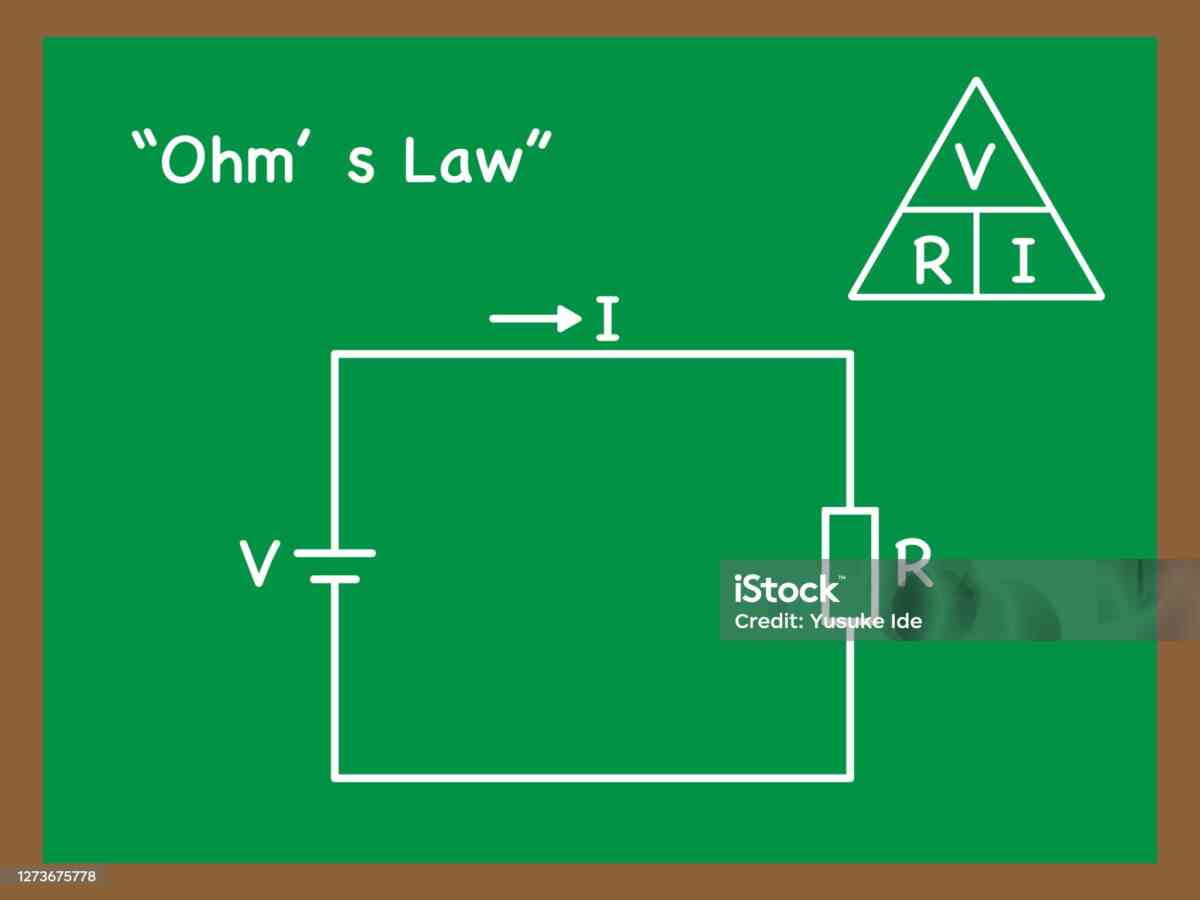
Ohm’s Law Triangle
A common way to remember Ohm’s Law is the V-I-R triangle.
Imagine three sections:
- V at the top
- I at the bottom left
- R at the bottom right
Cover the quantity you want to calculate.
If you cover V:
V = I × R
If you cover I:
I = V ÷ R
If you cover R:
R = V ÷ I
This simple method is particularly useful for students learning electrical formulas.
Understanding Voltage
Voltage is the electrical potential difference between two points.
Voltage is measured in volts (V).
Common voltage levels include:
- 1.5 V
- 3 V
- 5 V
- 9 V
- 12 V
- 24 V
- 48 V
- 120 V
- 230 V
Different electrical systems operate at different voltage levels.
Small electronic devices may use only a few volts, while household and industrial systems can operate at much higher voltages.
Understanding Current
Electrical current describes the movement of electric charge.
The standard unit is the ampere (A).
Smaller currents are commonly measured in milliamperes (mA).
The conversion is:
1 A = 1,000 mA
For example:
0.5 A = 500 mA
0.1 A = 100 mA
0.025 A = 25 mA
Correct unit conversion is important when using an Ohm’s Law Calculator.
Understanding Resistance
Resistance describes opposition to electrical current.
Resistance is measured in ohms (Ω).
Common resistor values include:
- 10 Ω
- 47 Ω
- 100 Ω
- 220 Ω
- 330 Ω
- 1 kΩ
- 4.7 kΩ
- 10 kΩ
- 100 kΩ
Remember:
1 kΩ = 1,000 Ω
Therefore:
4.7 kΩ = 4,700 Ω
How Voltage Affects Current
According to Ohm’s Law:
I = V ÷ R
If resistance remains constant, increasing voltage increases current.
For example, a 10 Ω resistor produces:
| Voltage | Current |
|---|---|
| 5 V | 0.5 A |
| 10 V | 1 A |
| 15 V | 1.5 A |
| 20 V | 2 A |
The relationship is proportional.
Doubling voltage doubles current when resistance stays constant.
How Resistance Affects Current
For a fixed voltage:
I = V ÷ R
Increasing resistance decreases current.
For a 12 V source:
| Resistance | Current |
|---|---|
| 2 Ω | 6 A |
| 4 Ω | 3 A |
| 6 Ω | 2 A |
| 12 Ω | 1 A |
| 24 Ω | 0.5 A |
| 120 Ω | 0.1 A |
This inverse relationship is fundamental to electrical circuit design.
Example: Calculating Current
Suppose a 5 V supply is connected to a 1 kΩ resistor.
Convert:
1 kΩ = 1,000 Ω
Use:
I = V ÷ R
Therefore:
I = 5 ÷ 1,000
I = 0.005 A
Convert to milliamperes:
0.005 A = 5 mA
So the current is:
5 mA
Example: Calculating Resistance
Suppose a circuit operates at 12 V and draws 0.25 A.
Use:
R = V ÷ I
Therefore:
R = 12 ÷ 0.25
R = 48 Ω
The equivalent resistance is 48 Ω under the assumed operating conditions.
Example: Calculating Voltage
Suppose current is 0.5 A and resistance is 20 Ω.
Use:
V = I × R
Therefore:
V = 0.5 × 20
V = 10 V
The voltage is 10 V.
Ohm’s Law and Electrical Power
Ohm’s Law is closely related to electrical power.
The basic power equation is:
P = V × I
Where:
- P = power in watts
- V = voltage
- I = current
For example:
Voltage = 12 V
Current = 3 A
P = 12 × 3
P = 36 W
The circuit consumes approximately 36 W under these conditions.
Power Formulas Derived From Ohm’s Law
You can combine Ohm’s Law with the power equation to create additional formulas.
Power from voltage and resistance
P = V² ÷ R
Power from current and resistance
P = I² × R
These equations are extremely useful when calculating resistor power dissipation.
Example: Resistor Power Calculation
Suppose a 100 Ω resistor is connected to 20 V.
First calculate current:
I = 20 ÷ 100
I = 0.2 A
Then calculate power:
P = V × I
P = 20 × 0.2
P = 4 W
Therefore, the resistor dissipates 4 W.
A practical design should select a resistor with an appropriate power rating and suitable operating margin.
Why Resistor Power Rating Is Important
Choosing the correct resistance is only part of resistor selection.
A resistor may be available with ratings such as:
- 0.125 W
- 0.25 W
- 0.5 W
- 1 W
- 2 W
- 5 W
- 10 W
If your calculation indicates that a resistor will dissipate 4 W, a tiny 0.25 W resistor would not be appropriate.
The resistor’s power rating must be suitable for the expected dissipation and operating conditions.
Ohm’s Law Calculator for LED Resistors
One of the most common uses of Ohm’s Law calculations is determining a current-limiting resistor for an LED.
A simplified formula is:
R = (Vs − Vf) ÷ I
Where:
- Vs = supply voltage
- Vf = LED forward voltage
- I = desired LED current
LED Resistor Example
Suppose:
- Supply voltage = 12 V
- LED forward voltage = 2 V
- Desired current = 15 mA
Convert:
15 mA = 0.015 A
Then:
R = (12 − 2) ÷ 0.015
R = 10 ÷ 0.015
R ≈ 667 Ω
A practical circuit would typically use an appropriate standard resistor value while keeping LED current within its specifications.
LED Resistor Power
The resistor drops:
12 − 2 = 10 V
Current:
0.015 A
Power:
P = V × I
P = 10 × 0.015
P = 0.15 W
Therefore, the resistor dissipates approximately 0.15 W.
The resistor should have an appropriate power rating.
Ohm’s Law and Voltage Drop
Voltage drop is another important application.
The formula is:
Vdrop = I × R
Suppose:
- Current = 10 A
- Resistance = 0.1 Ω
Then:
Vdrop = 10 × 0.1
Vdrop = 1 V
One volt is lost across the resistance.
Voltage Drop in Long Wires
Electrical wires have resistance.
The longer the wire, the greater its resistance generally becomes, assuming the conductor size and material remain the same.
When current flows through the wire, voltage drop occurs.
This can become important in:
- Automotive wiring
- Solar installations
- Battery systems
- RV electrical systems
- Marine electrical systems
- Industrial equipment
- Long-distance low-voltage circuits
Proper wire sizing helps reduce unwanted voltage drop.
Voltage Drop and Heat
Resistance does not only cause voltage loss.
It also causes power dissipation:
P = I²R
Suppose a cable connection has resistance of 0.02 Ω and carries 25 A.
P = 25² × 0.02
P = 625 × 0.02
P = 12.5 W
Twelve and a half watts of heat at one connection can be significant.
This illustrates why low-resistance connections are important in high-current systems.
Ohm’s Law in Series Circuits
Resistors connected in series add together.
The total resistance is:
Rtotal = R1 + R2 + R3 + …
For example:
- R1 = 100 Ω
- R2 = 200 Ω
- R3 = 300 Ω
Then:
Rtotal = 100 + 200 + 300
Rtotal = 600 Ω
If the source is 12 V:
I = 12 ÷ 600
I = 0.02 A
or:
20 mA
In an ideal series circuit, the same current flows through each component.
Ohm’s Law in Parallel Circuits
Parallel resistors require a different calculation.
For two resistors:
Rtotal = (R1 × R2) ÷ (R1 + R2)
Suppose:
- R1 = 100 Ω
- R2 = 200 Ω
Then:
Rtotal = (100 × 200) ÷ (100 + 200)
Rtotal = 20,000 ÷ 300
Rtotal ≈ 66.67 Ω
If connected to 10 V:
I = 10 ÷ 66.67
I ≈ 0.15 A
Why Parallel Resistance Decreases
When resistors are connected in parallel, current has multiple paths.
As a result, the equivalent resistance is lower than the smallest individual resistance.
For example:
10 Ω || 10 Ω = 5 Ω
10 Ω || 20 Ω ≈ 6.67 Ω
10 Ω || 100 Ω ≈ 9.09 Ω
This is an important concept in circuit analysis.
Ohm’s Law and Voltage Dividers
Voltage dividers use resistors to create a lower voltage from a higher voltage.
The formula is:
Vout = Vin × R2 ÷ (R1 + R2)
Suppose:
- Vin = 12 V
- R1 = 10 kΩ
- R2 = 5 kΩ
Then:
Vout = 12 × 5 ÷ 15
Vout = 4 V
This is an ideal unloaded calculation.
When a load is connected, the output voltage may change.
Voltage Divider Loading
A voltage divider works best when the load connected to its output has sufficiently high input resistance relative to the divider.
If the load resistance is low, it effectively becomes another parallel resistance.
This changes the divider ratio.
Therefore, a voltage divider should not automatically be assumed to produce its calculated voltage under every load condition.
Ohm’s Law and Automotive Electrical Systems
Ohm’s Law is frequently useful in automotive troubleshooting.
Applications include:
- Headlights
- Electric fans
- Relays
- Solenoids
- Heating elements
- Sensors
- Motors
- Wiring
- Ground connections
Suppose an automotive load has an approximate resistance of 3 Ω and receives 12 V.
I = 12 ÷ 3
I = 4 A
The theoretical current is 4 A.
Actual current may differ because many automotive devices are not simple fixed resistors.
Automotive Voltage Drop Testing
Voltage drop testing can identify excessive resistance in wiring and connections.
For example, suppose a high-current circuit carries 50 A and has 0.03 Ω of unwanted resistance.
Voltage drop:
Vdrop = 50 × 0.03
Vdrop = 1.5 V
Power dissipated:
P = 50² × 0.03
P = 75 W
That amount of heat could indicate a serious connection or wiring problem.
Ohm’s Law and Batteries
Battery-powered circuits can also be analyzed with Ohm’s Law.
Suppose a 12 V source powers a 24 Ω resistive load.
Current:
I = 12 ÷ 24
I = 0.5 A
Power:
P = 12 × 0.5
P = 6 W
However, real batteries have internal resistance and their terminal voltage changes depending on:
- State of charge
- Temperature
- Age
- Chemistry
- Load
- Discharge rate
Therefore, an ideal Ohm’s Law calculation does not completely model real battery behavior.
Ohm’s Law and Solar Energy Systems
Solar energy systems involve voltage, current, resistance, and power.
Suppose a solar-powered device operates at 24 V and consumes 4 A.
Power:
P = 24 × 4
P = 96 W
The load requires approximately 96 W at that operating point.
Real solar-system design also considers:
- Solar irradiance
- Panel output
- Temperature
- Charge-controller efficiency
- Battery losses
- Inverter efficiency
- Cable losses
- Peak demand
Ohm’s Law and Power Supplies
Power supplies are commonly rated according to voltage and maximum current.
Suppose a device needs:
- 12 V
- 2 A
The approximate power requirement is:
P = 12 × 2
P = 24 W
A power supply must provide the required voltage and enough current capacity for the application.
Additional capacity may be appropriate depending on startup current and system requirements.
Ohm’s Law and Resistor Networks
Complex circuits often use combinations of resistors.
Resistors can be connected:
- In series
- In parallel
- In series-parallel networks
The goal is often to calculate equivalent resistance before applying Ohm’s Law.
For a simple circuit:
Rtotal → I = V ÷ Rtotal
This makes Ohm’s Law a core building block for circuit analysis.
Ohm’s Law for Sensors
Some sensors change their resistance based on physical conditions.
Examples include:
- Thermistors
- Photoresistors
- Potentiometers
- Resistive position sensors
- Strain gauges
Suppose a sensor has resistance of 2 kΩ and is connected to 10 V.
Convert:
2 kΩ = 2,000 Ω
Current:
I = 10 ÷ 2,000
I = 0.005 A
or:
5 mA
If the sensor resistance changes, its current changes accordingly under constant voltage.
Thermistors and Ohm’s Law
Thermistors are resistive components whose resistance changes with temperature.
Two common categories are:
- NTC thermistors
- PTC thermistors
Because their resistance changes with temperature, Ohm’s Law can be used to calculate current at a particular resistance and voltage.
However, the resistance value itself must be obtained from the thermistor’s characteristics or measurement.
Ohm’s Law and Heating Elements
Heating elements are often treated as resistive loads.
Suppose a heating element has resistance of 20 Ω and operates at 120 V.
Current:
I = 120 ÷ 20
I = 6 A
Power:
P = 120 × 6
P = 720 W
The theoretical power is 720 W.
Actual heating elements can change resistance as their temperature changes.
Ohm’s Law and Incandescent Bulbs
Incandescent lamps provide an interesting example of nonconstant resistance.
The filament is much cooler when the lamp is off.
When voltage is applied, the filament heats up and its resistance increases.
Consequently, its cold resistance does not necessarily predict its normal operating resistance.
This demonstrates why Ohm’s Law should be applied with an understanding of the component’s operating characteristics.
Ohm’s Law and Motors
Motors require additional analysis.
A motor winding has resistance, but the motor also produces back EMF while rotating.
At startup, motor speed is near zero, so back EMF is low and current can be high.
As the motor accelerates, back EMF increases.
Therefore:
I = V ÷ R
using only winding resistance does not fully describe a motor’s running current.
Ohm’s Law remains useful, but motor analysis requires additional electrical and mechanical information.
Ohm’s Law and LEDs
LEDs are semiconductor devices with nonlinear current-voltage characteristics.
A small change in forward voltage can produce a substantial change in current.
Therefore, an LED should not generally be treated as a normal fixed resistor.
When designing an LED circuit, consider:
- Forward voltage
- Forward current
- Maximum current
- Temperature
- Supply voltage
- Current-limiting method
For simple applications, a resistor can often be used to limit current.
Ohm’s Law and AC Circuits
Ohm’s Law is especially straightforward for DC resistive circuits.
In AC circuits containing inductors and capacitors, impedance becomes important.
The generalized relationship is:
V = I × Z
where Z represents impedance.
Impedance includes resistance and reactance.
Therefore, a basic resistance calculator should not be confused with a complete AC impedance calculator.
Ohm’s Law and RMS Voltage
For sinusoidal AC systems, RMS voltage is commonly used.
For a purely resistive load:
I = Vrms ÷ R
Suppose:
- Vrms = 120 V
- R = 60 Ω
Then:
I = 120 ÷ 60
I = 2 A
Power:
P = 120 × 2
P = 240 W
This example assumes a purely resistive load.
Ohm’s Law and Electrical Troubleshooting
Ohm’s Law can be useful when comparing expected and measured electrical values.
Suppose a circuit is designed to operate at:
- 12 V
- 2 A
Its equivalent resistance is:
R = 12 ÷ 2
R = 6 Ω
If measurements show significantly different behavior, possible causes include:
- Incorrect resistance
- Wiring problems
- Poor connections
- Supply voltage issues
- Component failure
- Measurement errors
- Changing operating conditions
Ohm’s Law can therefore provide a starting point for troubleshooting.
Why Measurements May Differ From Calculations
Real circuits are rarely perfectly ideal.
Differences can result from:
- Resistor tolerance
- Temperature
- Wire resistance
- Battery voltage variation
- Connector resistance
- Component aging
- Measurement accuracy
- Nonlinear component behavior
For example, a resistor marked 100 Ω may not measure exactly 100 Ω because of its tolerance.
A calculation based on 100 Ω is therefore an idealized value.
Resistor Tolerance
Resistors commonly have tolerance specifications.
For example, a 100 Ω resistor with 5% tolerance may theoretically have a resistance anywhere within approximately:
95 Ω to 105 Ω
This affects actual current.
With a 10 V source:
At 95 Ω:
I ≈ 0.105 A
At 105 Ω:
I ≈ 0.095 A
Therefore, component tolerance can affect circuit performance.
Temperature and Resistance
Resistance can change with temperature.
Different materials have different temperature coefficients.
This matters in:
- Precision electronics
- Sensors
- Power resistors
- Automotive systems
- Industrial equipment
- High-temperature environments
For many basic calculations, resistance is treated as constant.
For precision applications, temperature effects may need to be considered.
Ohm’s Law and Circuit Protection
Current calculations can help estimate the expected electrical load.
If a resistive circuit operates at 24 V and has a resistance of 12 Ω:
I = 24 ÷ 12
I = 2 A
The expected current is 2 A.
Circuit protection must consider the actual application, conductor rating, startup conditions, fault conditions, applicable electrical standards, and equipment specifications.
An Ohm’s Law Calculator is not a substitute for proper electrical protection design.
Common Ohm’s Law Mistakes
Mistake 1: Confusing volts and amps
Voltage and current are different quantities.
Mistake 2: Forgetting unit conversion
For example:
10 kΩ = 10,000 Ω
not 10 Ω.
Mistake 3: Treating milliamps as amps
20 mA = 0.020 A
not 20 A.
Mistake 4: Ignoring power
A resistor may have the correct resistance but an insufficient wattage rating.
Mistake 5: Using the wrong circuit formula
Series and parallel resistance calculations are different.
Mistake 6: Assuming all electrical components are resistive
Motors, LEDs, capacitors, inductors, and semiconductor devices require additional consideration.
Ohm’s Law Calculator for Students
Students can use the calculator to verify homework and laboratory calculations.
A good learning process is:
- Write down known values.
- Identify the unknown.
- Select the correct formula.
- Convert units.
- Solve the equation manually.
- Use the calculator to verify the answer.
- Compare the results.
This approach encourages understanding rather than dependence on the calculator.
Ohm’s Law Calculator for Electronics Hobbyists
Electronics hobbyists frequently use Ohm’s Law when working with:
- LEDs
- Resistors
- Sensors
- Buttons
- Switches
- Relays
- Batteries
- Microcontrollers
- Small motors
- Voltage dividers
A free online calculator can save time when experimenting with different circuit values.
Ohm’s Law Calculator for Engineers and Technicians
Professionals may use Ohm’s Law as part of a broader engineering workflow.
It can support:
- Preliminary calculations
- Troubleshooting
- Design verification
- Load estimation
- Voltage-drop analysis
- Power calculations
- Component selection
More complex systems may require additional tools such as:
- Kirchhoff’s laws
- AC impedance calculations
- Circuit simulation
- Semiconductor models
- Thermal analysis
- Motor calculations
How to Check Your Calculator Result
Never assume that a calculator result is automatically correct.
Check:
Units
Are the values entered in the correct units?
Magnitude
Does the answer appear reasonable?
Formula
Did you calculate voltage, current, or resistance correctly?
Power
Could the component safely dissipate the calculated power?
Circuit behavior
Is the component actually a simple resistive load?
These checks can prevent many practical mistakes.
Quick Ohm’s Law Examples
| Known Values | Formula | Result |
|---|---|---|
| 12 V, 6 Ω | I = V/R | 2 A |
| 24 V, 12 Ω | I = V/R | 2 A |
| 10 V, 2 A | R = V/I | 5 Ω |
| 5 A, 4 Ω | V = I×R | 20 V |
| 12 V, 2 A | P = V×I | 24 W |
| 20 V, 100 Ω | P = V²/R | 4 W |
Ohm’s Law Formula Cheat Sheet
Voltage
V = I × R
Current
I = V ÷ R
Resistance
R = V ÷ I
Power
P = V × I
Power from current and resistance
P = I² × R
Power from voltage and resistance
P = V² ÷ R
Voltage drop
Vdrop = I × R
These formulas cover many common basic electrical calculations.
Benefits of Using a FREE Ohm’s Law Calculator Online
A free online calculator can provide several advantages.
Easy to access
It can be used from a computer, tablet, or smartphone.
No manual formula rearrangement
The calculator handles the mathematical relationship.
Helpful for beginners
New learners can see how voltage, current, and resistance relate.
Useful for professionals
Technicians can quickly check basic calculations.
Helpful for DIY projects
Hobbyists can estimate resistor values, currents, and power.
Useful for education
Teachers and students can use it as a supplemental learning tool.
When You Should Not Rely Only on an Ohm’s Law Calculator
A calculator is useful, but it has limitations.
Do not assume a simple Ohm’s Law calculation completely describes:
- Motors
- Transformers
- LEDs
- Diodes
- Transistors
- Capacitors
- Inductors
- Switching power supplies
- Complex AC circuits
These systems may require additional electrical models.
You should also consult manufacturer specifications when working with actual components.
Electrical Safety Considerations
Electrical calculations should always be combined with appropriate safety practices.
Low-voltage electronics projects can still create hazards through:
- Short circuits
- Battery overheating
- Excessive current
- Component failure
- Fire
- Stored electrical energy
Higher-voltage systems can present serious electric shock and arc hazards.
For mains electricity and industrial systems, appropriate qualifications, protective equipment, procedures, and applicable electrical codes should be followed.
Never use a basic online calculator as a substitute for professional electrical safety practices.
Frequently Asked Questions
What is the simplest Ohm’s Law formula?
The main equation is:
V = I × R
How do I calculate current?
Divide voltage by resistance:
I = V ÷ R
How do I calculate resistance?
Divide voltage by current:
R = V ÷ I
How do I calculate voltage?
Multiply current by resistance:
V = I × R
What does Ω mean?
Ω is the symbol for ohms, the unit of resistance.
What does A mean?
A represents amperes, the unit of current.
What does V mean?
V represents volts, the unit of voltage.
Can Ohm’s Law calculate electrical power?
Yes. Power can be calculated using:
P = V × I
Additional formulas include:
P = I²R
and:
P = V²/R
Can I use Ohm’s Law for LED circuits?
Yes. It can help calculate an LED current-limiting resistor, but the LED’s forward voltage and current specifications must be considered.
Can I use Ohm’s Law for batteries?
Yes, for basic calculations. Real batteries have internal resistance and variable voltage.
Can I use Ohm’s Law for automotive systems?
Yes. It can help calculate current, resistance, and voltage drop, although automotive components may have more complex behavior.
Is Ohm’s Law useful for wire calculations?
Yes. It can help calculate voltage drop when wire resistance and current are known.
Does Ohm’s Law work for AC?
It works directly for simple resistive AC loads. More complex AC circuits require impedance analysis.
Final Conclusion
A FREE Ohm’s Law Calculator is one of the most useful basic electrical calculation tools available to students, electronics hobbyists, technicians, engineers, and DIY users.
At the center of the calculation is the simple equation:
V = I × R
From this relationship, you can determine:
Voltage:
V = I × R
Current:
I = V ÷ R
Resistance:
R = V ÷ I
Ohm’s Law can also be combined with electrical power equations:
P = V × I
P = I²R
P = V²/R
These formulas are useful for understanding resistor circuits, LED projects, voltage dividers, batteries, power supplies, automotive systems, heating elements, wiring, and many other electrical applications.
The calculator can save time and reduce arithmetic mistakes, but understanding the underlying formulas remains important. Always verify units, consider component tolerance, check power ratings, and remember that real-world components such as motors, LEDs, batteries, and semiconductor devices may not behave as ideal resistors.
For simple resistive circuits, Ohm’s Law provides a powerful and easy-to-understand foundation. With a FREE online Ohm’s Law Calculator, these calculations become even faster and more convenient for everyday electrical analysis.


